

DNS Multiple QTYPEs (RFC 10029) and SEO Crawling Speed
DNS Multiple QTYPEs (RFC 10029) and SEO Crawling Speed
Every time a crawler visits your site, it has to ask a DNS server a few basic questions before it can even request the page. What’s the IPv4 address? What’s the IPv6 address? Does this domain support HTTPS records? For years, each of those questions has meant a separate round trip. RFC 10029, standardized in June 2024, changes that. It lets a client bundle multiple query types into a single DNS request. For a search engine crawler hitting millions of domains a day, that’s not a minor tweak. It’s a structural change in how fast a site gets discovered and indexed.
This matters for SEO because DNS resolution sits at the very start of the request chain, before Time to First Byte (TTFB), before rendering, before anything Google can measure on your page. If the lookup is slow, everything downstream inherits the delay.
The DNS Latency Problem: Three Questions Instead of One
Picture Googlebot arriving at a domain it hasn’t crawled recently. Before it can send an HTTP request, it needs to resolve the hostname. Under the traditional DNS model, that means separate queries for each record type it cares about: an A record for the IPv4 address, an AAAA record for IPv6, and increasingly an HTTPS record that tells the client which TLS parameters and ports to use.
Each of these queries is a full round trip: the resolver asks, waits, and answers. On a fast, warm connection, one query might take 10 to 30 milliseconds. That sounds trivial until you multiply it. Three sequential queries instead of one triples the DNS-related delay before the crawler even opens a TCP connection. Now multiply that by every URL a crawler needs to resolve, including subdomains, CDNs, and third-party resources referenced on the page.
For a single visitor, three DNS queries instead of one is invisible. For a crawler operating at Google’s scale, or for a local crawler auditing thousands of URLs in one session, the difference compounds. This is exactly the kind of protocol-level inefficiency that most SEO advice skips, because it lives below the layer most guides talk about. Articles on DNS usually stop at TTL settings or choosing a fast DNS provider. They rarely touch what happens at the packet level during resolution itself.
RFC 10029: One Query, Multiple Answers
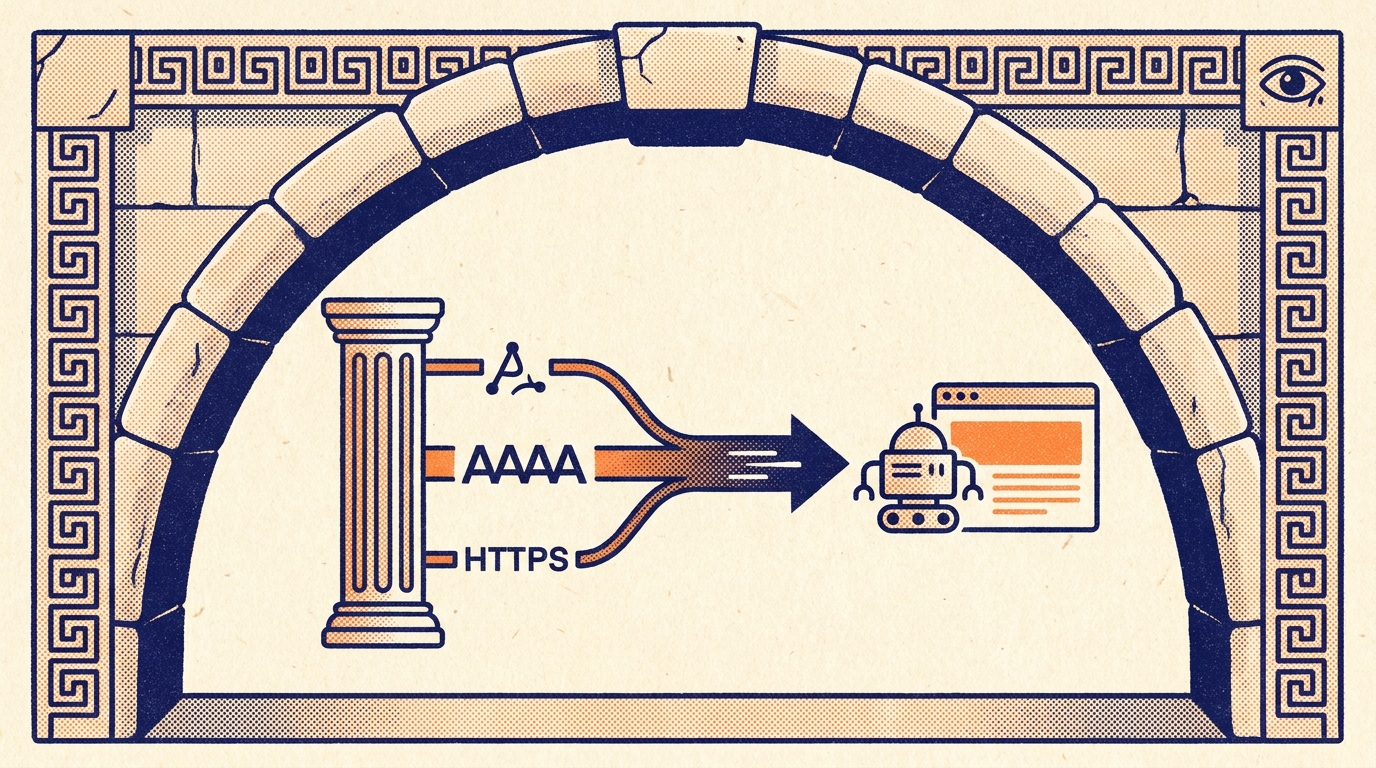
RFC 10029 solves this by letting a client specify more than one QTYPE (query type) in a single DNS message. Instead of asking three separate questions, a resolver can ask: give me the A, AAAA, and HTTPS records for this name, all at once. The authoritative server, if it supports the standard, returns everything in one response packet.
The mechanics are simple on paper but require support on both ends of the conversation. The resolver, the client making the request, has to know how to construct a multi-QTYPE query. The authoritative DNS server, the one hosting your domain’s records, has to know how to answer one. If either side doesn’t support the standard, the exchange falls back to the old, sequential method. That’s an important nuance: RFC 10029 doesn’t change anything until DNS providers and resolvers actually roll out support for it.
As of now, major DNS providers like Cloudflare, Google Public DNS, and AWS Route 53 are the ones to watch. None have publicly confirmed full production support yet, and Google Search Central has not made a statement on whether Googlebot’s resolvers use the new standard. That’s worth being direct about: this is an emerging opportunity, not a shipped feature you can already measure in your Search Console reports. Treat any numbers around expected latency savings as directional, not confirmed.
What Faster DNS Means for TTFB and Crawl Budget
DNS resolution time is one of the components rolled into Time to First Byte. TTFB, in turn, feeds into how Core Web Vitals and page experience are perceived, and it affects how quickly a crawler can move from one URL to the next. Shaving even a handful of milliseconds off every lookup adds up when a crawler resolves the same domain repeatedly, or when it crawls thousands of subdomains under one parent zone.
The bigger story is crawl budget. Google allocates a finite amount of crawling capacity to every site based on server responsiveness and perceived value. A DNS layer that used to require three sequential lookups per hostname, now requiring one, frees up that capacity for actually fetching and rendering pages instead of waiting on network round trips. For large sites with thousands of URLs, or sites split across many subdomains, this kind of protocol efficiency is a real lever, even if it’s invisible in most standard reports.
It’s worth being cautious about magnitude here. Industry estimates suggest DNS resolution can account for anywhere from 10% to 30% of total page load time on a cold connection, but that range varies heavily by network conditions and hasn’t been benchmarked specifically against RFC 10029 in production yet. Treat this as a trend worth monitoring, not a guaranteed win you can put a fixed number on today.
Preparing Your Infrastructure (and Your Audit Process) for the Change
You don’t need to wait for a Google announcement to start preparing. A few concrete steps make sense now.
First, check whether your DNS provider has a public roadmap or changelog mentioning multi-QTYPE query support. Cloudflare, Google Cloud DNS, and Route 53 all publish this kind of information, usually in their developer documentation or status pages.
Second, keep measuring your actual DNS resolution time as part of your regular technical audits, not just TTFB in aggregate. If you’re comparing crawlers to see which tools give you this level of detail, a piece like our comparison of the best SEO crawlers covers what to look for beyond basic link checking.
Third, don’t treat this as a reason to neglect the fundamentals. Sensible TTL values, a responsive authoritative DNS provider, and a CDN with wide anycast coverage still matter more today than a standard that’s still rolling out. RFC 10029 is additive, not a replacement for good DNS hygiene.
Seodisias, as a free, cross-platform desktop crawler for Windows, macOS, and Linux, is built for exactly this kind of technical auditing. It runs locally, so your crawl data never leaves your machine, and it includes JavaScript rendering without pushing that feature behind a paywall. Watching how protocol changes like RFC 10029 roll out, and measuring their real effect on your own domains, is easier when you’re not fighting a URL limit or a registration wall just to start a crawl.
Closing Thoughts
RFC 10029 is a small protocol change with an outsized potential effect on crawl efficiency. It won’t rewrite your rankings overnight, and adoption is still in its early stages across resolvers and authoritative DNS providers. But for a technical SEO audience that already thinks in terms of TTFB, crawl budget, and protocol-level optimization, it’s worth tracking now rather than after it becomes mainstream.
Start by auditing your own DNS resolution times and keep an eye on your provider’s support for the standard. If you want a free, local way to run that audit without hitting a URL cap, try Seodisias.
Looking for something else?
Search every guide on the blog without going back to the list.